1. The Game of Pig (Grades 3–8)
Math concepts: This game for two or more players gives students practice with mental addition and experience with thinking strategically.
The object: to be the first to score 100 points or more.
How to play: Players take turns rolling two dice and following these rules:
1. On a turn, a player may roll the dice as many times as he or she wants, mentally keeping a running total of the sums that come up. When the player stops rolling, he or she records the total and adds it to the scores from previous rounds.
2. But, if a 1 comes up on one of the dice before the player decides to stop rolling, the player scores 0 for that round and it's the next player's turn.
3. Even worse, if a 1 comes up on both dice, not only does the turn end, but the player's entire accumulated total returns to 0.
After students have had the chance to play the game for several days, have a class discussion about the strategies they used. You may want to list their ideas and have them test different strategies against each other to try and determine the best way to play.
______________________________________
2. Two-Dice Sums (Grades 1–8)
Math concepts: Students of all ages can play this game, as long as they're able to add the numbers that come up on two dice. While younger children benefit from the practice of adding, older students have the opportunity to think about the probability of the sums from rolling two dice.
The object: to remove all the counters in the fewest rolls possible.
How to play: Two or more players can play. Each player needs 11 counters, a game strip that lists the numbers from 2 to 12 spaced far enough apart so the counters can fit on top of each number, and a recording sheet. Here are the rules for playing:
1. Each player arranges 11 counters on the game strip and records the arrangement.
2. Once the counters are arranged, players take turns rolling the dice.
3. For each roll, all players can remove one counter if it is on the sum rolled. Players keep track of the number of rolls of the dice it takes to clear their game board.
After students have had the chance to play the game for several days or so, have a class discussion about the different ways they arranged the counters and the number of rolls it took. Have them write about the arrangements that are best for removing the counters in the fewest number of rolls. For an extension, try Which Number Wins?
______________________________________
3. Which Number Wins? (Grades 1–8)
Math concepts: In this individual activity, students roll two dice and record the results. Make a recording sheet that is an 11 x 12 block grid with the numbers 2 through 12 across the top. While young children gain practice with addition facts, older children can examine the data, compare results with other classmates, and think about why some sums are more likely than others. To do the activity, students need two dice and a recording sheet.
The object: to roll the dice and record the number fact in the correct column, stopping when one number gets to the finish line.
How to play: Post a class chart that lists the numbers from 2 to 12 and have students make a tally mark to show the winning sum. Have each child do the experiment at least twice.
After you've collected the data, discuss with the class why it seems that some sums "win" more than others. Young children may not be able to explain it, but older students often figure out that there is only one way to get the sums of 2 and 12, and six ways to get a sum of 7.
After discussing the data, return to the game of Two-Dice Sums and see if students revise their strategies. You may want to ask students to write about the game and the likelihood of two-dice sums.
____________________________________
4.Calculator Puzzle
You will need a calculator and a pencil and some paper.
You may only use these buttons: 2 3 4 5 6 7 8 9 + - =
Can you show 10 on the calculator? Write down how you did it.
Find lots of different ways you can make 10. Write them all down.
Can you make 100 in the same way? There are obviously many variations on this theme!
_____________________________________
5. A - Ten - Tion
LEVEL Grades 1 - 2
SKILLS
· place value -- numbers to 100
· odd/even
PLAYERS 2 or more
EQUIPMENT
· playing cards Ace (=1) through 9
· die
· paper and pencil
GETTING STARTED
Each player takes two cards from the deck and uses them to create a 2-digit number between 11 and 99. Players say aloud the number they create.
Player 1 rolls the die to determine who will win 10 points for the round.
· If the die lands on an odd number (1, 3, 5), the player who created the lower 2-digit number wins 10 points.
· If the die lands on an even number (2, 4, 6), the player who created the higher 2-digit number wins 10 points.
Players continue building numbers and alternating the roll of the die. The first player to accumulate 100 points is the winner.
VARIATION
Two dice may be used; add them together before determining if the roll is odd or even
______________________________________
6. Place Value War
LEVEL Grades 2-6
SKILLS
· identification of two-digit numbers
· comparing
· place value
PLAYERS 2
EQUIPMENT
· playing cards Ace (=1) through 9
· die
· paper and pencil
GETTING STARTED
Players divide the playing cards evenly between themselves. Each player turns over two cards to create a 2-digit number. The number on the first card turned over represents the number that will appear in the tens place; the number on the second card represents the number that will appear in the ones place.
Both players call out their numbers. (You might have them verbalize: "Six tens and two ones equals sixty-two.") The player with the largest number gets all four cards.
In the event of a tie (if each player has the same 2-digit number), war is declared.
· First, each player places three cards face down.
· Then each player turns over two more cards and adds the second number created by those cards to the first number.
· The player with the largest sum gets all of the cards.
Examples:
--- Player 1 pulls the cards 6 and 8 to create the number 68.
--- Player 2 pulls the cards 7 and 2 to create the number 72.
--- Player 2 collects all the cards.
--- Player 1 pulls the cards 4 and 3 to create the number 43.
--- Player 2 pulls the cards 4 and 3 to create the number 43.
--- In this "war" situation, each draws three more cards the are kept face down.
--- Then Player 1 draws two more cards and turns them over. He uses the cards, a 6 and a 2, to create a new number (62). He adds 62 to the original number (43) for a total of 105.
--- Player 2 turns over two more cards, a 1 and a 9. She adds the new number (19) to the original number (43) for a total of 62.
--- Player 1 has the larger total number, so he collects all of the cards.
Play continues until one player has collected all of the cards in the deck.
______________________________________
7. Climb the Ladder to 100
LEVELS
Grades 1 - 3
SKILLS
· place value
· adding numbers to 100
· vertical addition
PLAYERS 2
EQUIPMENT
· playing cards Ace (= 1) through 9
· paper and pencil
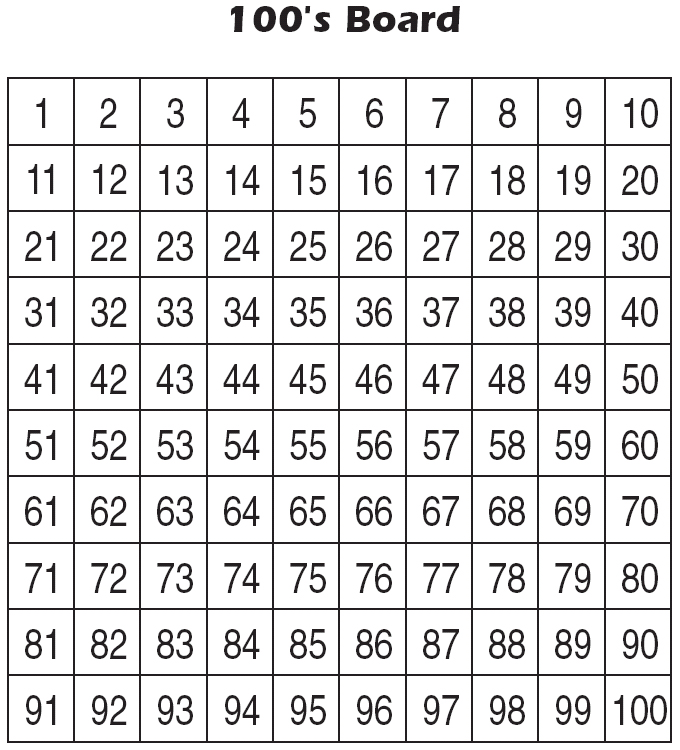
· 100's Board (optional)
GETTING STARTED
Player 1 turns over a card and records the number on his paper. Player 2 turns over the next card and records the number on her paper. Players continue to alternate turning over cards; they record each number on their papers as a running vertical addition math problem.
Example:Player 1 turns over a card with the number 6 on it. The next turn he turns over a 5. On his third turn he turns over an 8. The math problem that results looks like this:
6
+ 5
___
11
+ 8
___
19
The first player to reach a total of exactly 100 is the winner. Players must wait for the turn of the card that equals exactly 100.
For example, in order to win, a player with a total of 98 must turn over a card with the number 2 on it; or she must turn over two Aces (=1) on subsequent turns.)
Cards are reused until one player reaches 100.
Players may need counters or a 100's Board to help them find their sums.
VARIATION
At grades 1 and 2, students might use a die instead of playing cards. At grade 3, you might increase the game's difficulty by using two dice.
______________________________________
8. Multiplication Fish
LEVELS Grades 2 - 3
SKILLS
· beginning multiplication facts to 16
PLAYERS
· 2 - 4
EQUIPMENT
· deck of playing cards, Jokers removed; Jack = 12, Queen = 14, and King = 16
· a
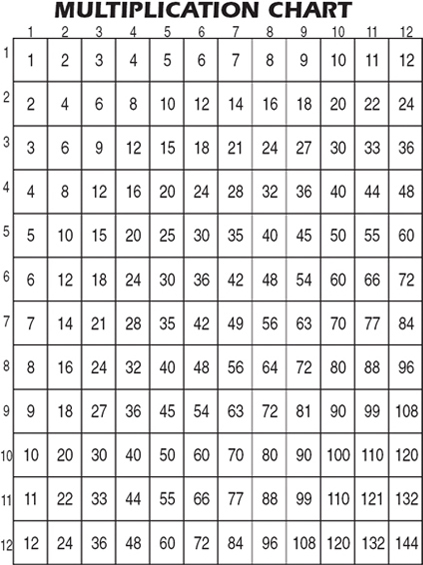
· multiplication table to during the game (if needed)
GETTING STARTED
Deal five cards to each player. The remaining cards are placed face down in a deck, which is placed in the middle of the playing area. The object of this game is for players to collect pairs of cards with the same number (value) on them. They will search for cards with numbers that match numbers they already hold in their own hands. If any player gets a matched set of cards among the five cards dealt at the start of the game, that player places the matched cards down on the table in front of themselves.
Players alternate turns as they ask another player if she or he has a certain card in their hand. Players ask their questions in the form of a multiplication question.
Example:
· Do you have any 2 x 5's (10's)?
· Do you have any 3 x 2's (6's)?
· Do you have any 7 x 1's (7's)?
If the player asks Do you have any 2 x 5's? to a player who has a 10 in his hand, that player must give up his 10 to the player who asked the question. The player who asked the question now has a pair of 10's. She puts them down in front of herself.
Each player may continue asking questions until they are unsuccessful in finding a match. If a player does not have the number asked for, she says "Fish" and the player asking the question takes a card from the top of the deck. If that card results in a match, he puts down the matched set in front of himself. If there is no match, he keeps the card in his hand and the next player takes her turn.
Play continues until one player is out of cards. Players count up their pairs. The player with the most pairs is the winner.
______________________________________
9. Penny Dice Game
Materials:
10 pennies for each player
1 die for each partnership or group
Number of Players:
Two (2) or more
Directions:
Partners pool their pennies to make 20. They take turns rolling the die and picking up as many pennies as the number on the die. To pick up the last pennies, the number on the die must match the number of pennies remaining.
The game ends when the last pennies have been picked up. The child with the most pennies wins the round.
Option: At the end of a round, children may flip a penny to determine whether the player with the most or least pennies will win that round. Heads means the highest number of pennies
______________________________________
10. Twenty Five
The objective of this game is to practice addition and subtraction using mental math.
Materials Needed
Playing cards numbered 1-9. You can make your own or use a commercially made set.
Game Rules
· Deal out all the cards, an equal number to each player. The cards are left facedown in a pile in front of each player.
· The person to the dealer's left goes first, and play continues clockwise.
· The first person turns over a card and places it faceup in the center of the play area.
· The next person turns over a card, adds it to the card already played, says the sum out loud, and places the card on top of the previously played card.
· The next person turns over a card and adds the card to the sum of the first two cards.
· Play continues in this way until someone has a card that when added will give a sum greater than 25. When that happens, the player must subtract rather than add.
· Play continues until someone gets a sum of exactly 25.
· The player who gets a sum of exactly 25 wins that round and goes first in the next round.
Subscribe to:
Post Comments (Atom)

No comments:
Post a Comment